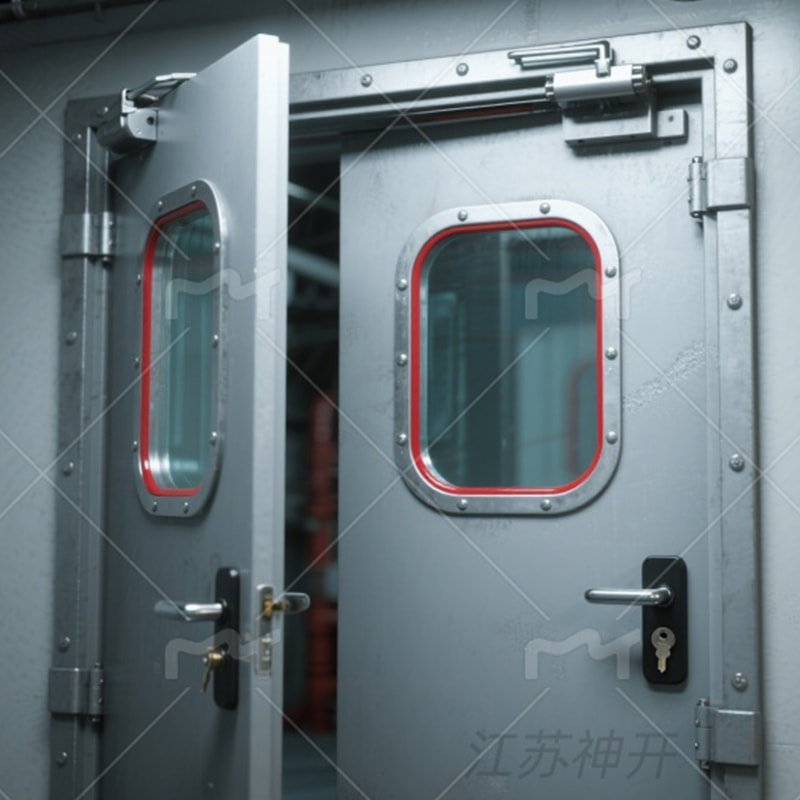

Marine outfitting is the shipbuilding phase where every functional system a vessel needs — piping, electrical networks, deck machinery, cabins, navigation electronics, and life-saving gear — is installed into a hull that, on its own, is just a welded steel shell.
It begins once the hull structure is complete and typically accounts for around a fifth to a quarter of a vessel's total build cost, which means the equipment decisions made during this phase have an outsized effect on the ship's final price, delivery date, and years of service life.
A completed hull is a hollow, unpowered shell. It has no way to generate electricity, move fluids, steer, communicate, or support a crew for more than a few hours. Outfitting is the work that turns that shell into a vessel capable of operating independently at sea — every mechanical, electrical, and habitability system that isn't part of the steel structure itself falls under this phase.
The split matters commercially because the two phases are priced, scheduled, and staffed in very different ways. Hull work is steel-cutting and welding labor measured against tonnage processed, with manpower alone often making up around half of that phase's cost and raw materials adding roughly another quarter. Outfitting runs on a different model entirely: it's procurement- and integration-driven, pulling together dozens of vendor-supplied systems that all have to be sourced, sequenced, and made to work together inside a fixed steel envelope.
Outfitting isn't one trade — it's a cluster of specialized disciplines that all happen inside the same hull, usually overlapping in time. In practice, most yards organize the work into these recognizable categories:
"Equipment" in an outfitting context isn't one product category — it's the combined total of everything a vessel's classification society requires plus everything its intended trade demands. The table below groups the major equipment families by function, which mirrors how shipyards and equipment suppliers typically structure procurement lists.
| System | Typical equipment | Primary function |
|---|---|---|
| Deck machinery | Anchor windlasses, mooring winches, capstans, cranes, hatch cover actuators | Anchoring, mooring, cargo handling |
| Piping & machinery | Main engine, auxiliary generators, pumps, compressors, valves, heat exchangers | Propulsion and onboard fluid/power systems |
| Electrical & electronic | Switchboards, cabling, lighting, automation and control panels | Power distribution and system control |
| Navigation & communications | Radar, GPS, electronic chart systems (ECDIS), VHF and satellite radio, AIS | Safe passage and vessel tracking |
| Life-saving appliances (LSA) | Lifeboats, life rafts, lifejackets, immersion suits, EPIRBs, lifebuoys | Emergency survival and rescue |
| Fire-fighting appliances (FFA) | Fixed suppression systems, detection panels, portable extinguishers, fireman's outfits | Fire detection, containment, and suppression |
| Accommodation & interior | Cabin furniture, galley equipment, insulation, deck coverings, doors and windows | Crew habitability and comfort |
The relative weight of each category shifts with vessel type. A container ship leans heavily on deck machinery and cargo-handling gear, while a passenger vessel shifts spend toward accommodation fit-out and life-saving equipment — passenger ships are generally required to carry survival equipment for effectively everyone aboard, a far higher ratio than cargo vessels need for a much smaller crew.
Deck machinery is the most visibly mechanical category of outfitting equipment, and it's where equipment-selection decisions have the clearest operational consequences. Three pieces of gear dominate this category, and they're frequently confused with one another even by people who work around them daily.
A third type, the capstan, is often mistaken for one of the two above. On a capstan, the driving machinery sits below deck while the cable lifter or barrel is mounted above it and driven by a vertical shaft — a configuration chosen when deck space or headroom is limited. Capstans are usually rated for a pull somewhere between 3 and 20 tonnes and can run on either electric or hydraulic drive.
Drive type is a real operating-cost decision, not a formality. Deck machinery is generally available with low-pressure hydraulic, high-pressure hydraulic, or electric drive, and the right choice depends on the vessel's existing power plant, redundancy requirements, and how often the gear runs under heavy load. Hydraulic systems tend to handle sustained high loads more comfortably, while electric drives simplify maintenance on vessels that don't already run a centralized hydraulic power unit.
No other equipment family in outfitting is as tightly regulated — or as commonly flagged during inspection — as life-saving and fire-fighting appliances. International safety rules organize this equipment into a small number of mandatory categories, each governed by detailed performance and installation standards rather than general guidance.
The equipment list isn't arbitrary — it's built around how long a survivor realistically needs to last before rescue arrives, and it scales with the voyage's risk profile. A full-scope survival pack, required for unrestricted and long international voyages, is built to sustain someone for an extended period: a buoyant rescue line, a knife, bailers, sea anchors, a repair kit, pyrotechnic signals, a first-aid kit, thermal protective covering, and a food and water ration calculated per person. A reduced pack, permitted only on shorter routes where rescue is expected quickly, keeps the core survival tools but drops the food and water allowance and carries fewer signal flares.
Fire protection follows the same logic of layered, purpose-matched equipment rather than a single catch-all device. Machinery spaces need a fixed extinguishing system — commonly CO₂, high-expansion foam, or water mist — plus a separate local-application system focused on the highest-risk components inside the engine room, backed up by portable extinguishers chosen to match the specific fire risk of whichever space they're stored in. Firefighting outfits worn by crew must be complete kits: protective clothing, boots, gloves, a helmet, a safety lamp, an axe, and self-contained breathing apparatus, with a minimum of two full outfits carried and more required on larger or passenger vessels.
The deficiencies that show up most often in life-saving equipment inspections aren't exotic failures — they're maintenance items that got deferred. Corroded or untested release hooks on lifeboats, expired hydrostatic release units on life rafts, EPIRB batteries past their service date, mooring wire falls beyond their renewal window, expired flares, and lifeboat engines that won't start on the first try are the recurring items port inspectors check first, precisely because they're the ones most likely to have slipped.
Outfitting used to be treated as a strictly sequential phase: finish the hull, launch it, then start installing equipment. In that conventional model, the entire hull structure is fabricated and erected on the berth first, and outfitting only begins once the ship is in the water — a sequence that has historically stretched total build time considerably longer than it needed to be.
Most modern yards have moved away from that approach. Advanced outfitting installs equipment into hull blocks and modules before those sections are ever erected or launched, taking advantage of the fact that access is far easier on a flat, open block sitting on a platen than inside an assembled hull. This ranges from something as simple as a single piece of equipment bolted to its own foundation and ready to drop into place, up to a fully pre-assembled unit that combines equipment, piping, and electrical wiring on one support structure before it ever reaches the ship.
The tradeoff is coordination complexity. When the systems being outfitted aren't properly sequenced or integrated against each other, the resulting delays and rework can add somewhere in the range of 5 to 10 percent to total project cost — which is why larger yards increasingly plan outfitting sequences digitally before equipment ever reaches the floor, rather than resolving clashes after installation has already started.
Because outfitting equipment is procured from dozens of separate vendors rather than fabricated in-house, its cost is harder to pin down early than steel and welding labor — and it's typically the line item most likely to run over budget on a first estimate.
| Cost category | Typical share of total build cost |
|---|---|
| Hull & structure | Around 25% |
| Machinery & propulsion | 30–35%, generally the single highest-value component |
| Electrical, electronic & navigation | 15–20%, a share that has grown as automation has expanded |
| Outfitting, paint & accommodation finishing | Roughly 20–25% overall |
Time follows a similar pattern to cost. Industry duration studies place outfitting among the most labor-intensive stages of the entire build, averaging somewhere between 18 and 24 months on a large vessel — often longer than hull erection itself. The gap is widening further on complex ships: outfitting-related work can now account for as much as 70 percent of total construction effort on the most sophisticated vessel types, even though it doesn't dominate the headline cost split the way hull steel once did on simpler ships.
Owners and yard procurement teams rarely choose outfitting equipment on price alone. In practice, four factors consistently outweigh sticker cost:
Weight and space matter more during outfitting than in almost any other phase of vessel design, simply because the hull's dimensions are already fixed by the time this phase begins. Equipment chosen without accounting for the vessel's actual available deck space or below-deck volume is a common source of late-stage rework — and rework at this point is expensive precisely because the surrounding structure is already built, and often already painted or insulated.
Introduction to Marine Spiral Duct In the demanding environment of the marine industry, reliable air distribution and exhaust systems are crucial to e...
READ MOREIntroduction to Marine Ropes What are Marine Ropes? Marine ropes, often referred to as lines in nautical terms, are a fundamental component of any boa...
READ MOREIntroduction In today’s globalized world, the demand for efficient and reliable ship refrigeration has become more critical than ever. As internationa...
READ MORE1. Introduction to Marine Cold Storage Panels and Their Role in Seafood Preservation Marine cold storage panels are an essential component in ensuring...
READ MORE+86 18036286112
No. 11, Jinli East Road, Hengji Town, Jianhu County, Yancheng City, Jiangsu Province, China
Copyright © Jiangsu Shenkai Marine Equipment Co.,Ltd. All Rights Reserved.

Custom Marine Equipment Manufacturers